
China’s Growing Demand for Iranian Petrochemical Products
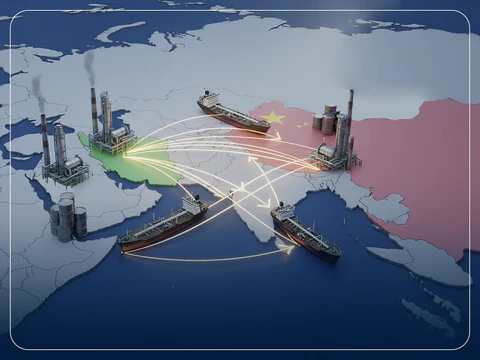
China's energy imports – a mix of oil and gas and petrochemical feedstocks – have made it a significant partner of Iran. China is today the largest market in the world for Iranian energy exports: petroleum, gas and petrochemical products combined make up around half of Iranian exports. Chinese firms in the recent Iranian calendar year purchased an estimated $4.5 billion of Iranian non-oil commodities in just four months and reached an annual delivery of $14.8B (around 25% of Iranian commodities) to Chinese markets. Chinese importers buy the great majority of Iranian bulk petrochemicals and fuel gases. Politically it is framed as a signal of deep strategic cooperation. This report takes a closer look at Chinese demand in petrochemicals from Iran (Iran petrochemical exports to China), highlighting key products and market opportunity and key logistical, sanction and payment challenges faced by exporters. First we look at the broad-based Iran–China trade relationship and then at the key petrochemical commodities shipped to Chinese markets. We touch on how sanctions and logistics make these shipments challenging and finish up with the 2025 outlook in the same time frame when Chinese petrochemical demand is strong. The idea is to frame how Iranian petrochemical exports to Chinese markets sit in the changing Chinese energy import profile and how gains may accrue to both.
Overview of Iran-China Trade Relations
Iran–China trade has risen considerably in recent years. China is the biggest non-oil trading partner of Iran: bilateral non-oil trade in FY2024 (to March 2025) reached around $34.1 billion. During the period, Iran shipped $14.8 billion worth of goods to China – around 25% of non-oil Iranian exports – and China is thus by a huge margin Iran's largest customer outside of oil. At the same time, China exported around $19.3 billion worth of goods (27% of Iranian import purchases) to Iran. These numbers highlight the central role of China; even in early 2025 half the exports of Iran went to China. For instance, China imported Iranian products worth $4.5 billion in only the initial four months of 2025 alone, as reported by Iran's customs authorities. By way of comparison, Iran's other big partners (such as the UAE or Turkey) import much smaller proportions of Iranian output. Non-oil exports to China involve minerals and base metals, food products, and increasingly energy products (fuel and petrochemicals). State authorities are keen to emphasize these numbers as proof of strong economic cooperation between Tehran and Beijing. As a whole, Iran–China trade relations today are based on a combination of energy flows (which are now captured by Chinese oil/petrochemical import flows) and Chinese machinery and consumer goods exports to Iran.
Historical Ties and Recent Trends
China and Iran have centuries of commercial and cultural linkage. Iranian leaders speak of "thousands of years" of relations and recent discussion cements an age of strategic cooperation. During 2024–25 both countries hosted business forums and bilateral consultations to deepen industry, technology, and infrastructure cooperation. For example, the Chinese ambassador in Iran has reported saying that "Beijing is fully committed to widening cooperation in all fields". This rhetoric masks how central the bilateral relationship has become. Iranian–Chinese trade has on balance attained a mature stage: China supplies to cover much of Iranian export demand (particularly in energy and petrochemicals), while Iran provides key inputs and markets to Chinese industry.
Key Petrochemical Products Exported to China

Iran's petrochemistry sector manufactures an assortment of products, and a bulk is exported to China. Key segments comprise fuel gases (such as LPG) and bulk chemicals (methanol, polymers, etc.). Top Chinese exports in 2024–25 were:
• Methanol: A basic chemical used in plastics and antifreeze. Iran exported about 4.3 million metric tons in the first half of 2024 (15% more than a year earlier). Roughly 80% of that methanol was sold to Chinese buyers.
• Polyethylene (PE): A common plastic for packaging and film. Iran shipped about 1.8 Mt of PE (LDPE+HDPE) in H1 2024 (an 11% rise). About two-thirds of Iran’s PE exports went to China.
• Mono-Ethylene Glycol (MEG): Feedstock for polyester fibers and PET. Exports reached roughly 0.6 Mt in H1 2024 (up 11%), with ~80% bound for China.
• Liquefied Petroleum Gas (LPG): A mix of propane and butane used as fuel and chemical feedstock. Iran’s LPG exports surged to about 7.9 Mt in Jan–Sep 2024. Chinese terminals in southern China received about 5.4 Mt of that fuel (~68% of exports); independent analysis suggests roughly 80% of Iranian LPG ultimately goes to China.
These statistics represent China's overriding position: it absorbs the vast majority of Iranian petrochemical production.
Major Iranian Petrochemical Foreign Sales (H1 2024) and Chinese Share:
| Petrochemical | Exports H1 2024 (Mt) | China’s Share (%) |
| Methanol | 4.3 | 80 |
| Polyethylene (LDPE+HDPE) | 1.8 | 66 |
| Mono-Ethylene Glycol (MEG) | 0.6 | 80 |
| Liquefied Petroleum Gas (LPG) | 7.9 (Jan–Sep) | 68 (≈80) |
China's reliance is however limited to these. Smaller quantities of other chemicals (e.g. fertilizers, aromatics) are also sent by Iran to China but in the majority Chinese purchasers prefer Iranian petrochemicals due to price superiority and traditional trade relations.
Expanding Petrochemical Output
Iran has been gradually increasing petrochemicals output to meet demand. New capacity and expansion in the early 2020s added to production of several key products. For example, expansion of the South Pars gas fields and new petrochemical facilities added to LPG and methanol production. Much of this incremental tonnage goes to China: larger increases in H1 2024 methanol and PE exports were primarily driven by Chinese buying. Iranian producers will add even larger shipments in coming years if they continue to add capacity. Iranian players will be forced to improve in quality and handling as well in order to compete in China's market (where even customers may prefer suppliers from the region and other regions).
Challenges in Logistics, Sanctions & Payments
Trading petrochemicals with China is not easy. At the top of the list are the effects of sanctions, long distances of shipment, and few payment routes. The large challenges are:
• Sanctions and Financial Barriers: U.S. and allied sanctions target Iran’s energy sector, and often Chinese entities as well. In 2025 the U.S. imposed sanctions on two Chinese oil refiners for buying Iranian oil, causing other buyers to hold back. Large Chinese banks and insurers avoid Iran, and major ports (like Shandong) have banned tankers linked to sanctioned importers. As a result, even legal exports face delays and added scrutiny.
• Complex Shipping: Iranian petrochemicals typically travel from Gulf ports to China by sea – a journey of several thousand miles. To evade detection under sanctions, exporters use convoluted routes and tactics. Vessels may turn off AIS location beacons, conduct ship-to-ship transfers at sea, or relabel cargo origins. These covert methods raise transport costs and delivery times, and limit the size of shipments (often using smaller tankers or coasters).
• Payment Difficulties: Most global trade is settled in dollars or euros, but Iranian exporters cannot easily use Western banking. To cope, Iran and China increasingly use alternative payment methods. These include direct yuan settlement (via China’s CIPS system) and currency swaps. Barter trade is also common: Iran often exchanges oil or petrochemicals for Chinese machinery, consumer goods or technology. Smaller Chinese banks (less afraid of U.S. reprisals) are used for accounts. Nonetheless, these workarounds introduce delays and sometimes exchange losses.
Each of these matters renders exporting much harder. Nonetheless, Iran and China have found ways to prevent problems from stopping their trade.
Sanctions Evasion and Payment Workarounds
In reality, exporters are dependent on ingenious strategies. Oil and chemicals may initially arrive at an innocuous port (e.g. Syria or Oman) and then re-routed to China afterwards. Others establish local subsidiaries to trade or mark shipments through third countries. On payments, it is helpful that China promotes a de-dollarized environment (e.g. the CIPS yuan-clearing system). Under Iranian leadership, many of the contracts are in renminbi and settled through cross-border interbank transfers. Barter transactions eliminate the problem of currency needs entirely: e.g. Iranian petrochemicals may be sent in exchange for Chinese construction equipment or electronics. Strategies like these diminish the risk of frozen funds but introduce complexity. Combined with stealth shipping (switching off ship trackers or employing "flags of convenience" by tanker ships), these have enabled China to be the largest purchaser of Iranian petrochemicals despite sanctions.
Future Outlook and Opportunities for 2025
In the coming years, the Chinese petrochemical market will be huge even while overall oil demand within the nation levels off. The IEA notes Chinese fuel usage has flattened but petrochemical feedstock demand continues to increase. New petrochemical complexes will demand increasingly LPG and naphtha and ethane and other feedstocks. Notably, China is bringing online massive capacity – e.g., ethylene production capacity will rise by an estimated 40 Mt within the 2025-2028 period. Even with this addition of capacity, however, China will still import massive levels of raw material, because domestic and feedstock supply still come up short of needs.
Factors That Could Boost Trade
- Ongoing Need: Chinese government policies entail industry growth. Demand is forecast to rise in mid-2020s to keep feedstock prices moderately robust. Chinese refiners might be supported in their effort to improve margins by Iranian low-cost production.
- Sino-Iranian Investment and Co-operation Projects: Chinese investment has been invited in Iranian petrochemical industry and infrastructure by Iran. As part of bilateral developmental schemes, China might assist in establishing new plants or pipeline connections. For instance, negotiations have been on a proposed oil and natural gas pipeline to China and widening rail connections. If achieved, these projects would ease logistics and bind the industries closer.
- Challenging Global Supplies: China currently imports massive volumes of U.S. ethane and LPG to supply its crackers, but political considerations (such as U.S. export restraints or spot price surges) may bring Iranian alternatives into the equation. The region is perfectly positioned to provide Middle East LPG and methanol alternatives, if it can capture other shippers or partners.
Overall, in 2025 and subsequent years Chinese petrochemical demand is expected to be robust. The Iranian opportunity is to capitalize on an Iranian production and low-cost advantage to capture market share. Lax sanctions or emergence of novel payment vehicles (like special renminbi bonds or domestic clearing banks) may pull formal exports up from today levels. Even in today's world the consistency and steadiness of Chinese demand for chemicals and plastics mean long-term Iranian export opportunity.
Iran–China Non-Oil Trade (Year ended March 2025) :
| Trade Flow | Value (USD) | Share of Iran’s Total Trade |
| Exports to China | $14.8B | ~25% of Iran’s exports |
| Imports from China | $19.3B | ~27% of Iran’s imports |
Conclusion
China's demand for Iranian petrochemicals is obvious: Chinese companies now dominate Iran's methanol, plastics and LPG production. According to some estimates Chinese companies purchase roughly 80% of Iranian methanol and LPG exports. The long-term prospect is great, as China's petrochemicals market is expected to continue expanding. Exporters face severe challenges, however. U.S. sanctions and secondary penalties have interrupted typical shipping and financing channels. Iranian and Chinese parties have turned to alternative payments ( yuan, barter) and clandestine shipping to sustain commerce. Overall, while Chinese oil products demand is likely to plateau, petrochemical feedstock demand is strong and provides an Iranian market. Sanctions management and trust-building will determine the fate of this commerce: if exporters are able to sort through logistic and payment challenges, Chinese massive energy imports will likely sustain Iranian petrochemicals.